IT
IT  ES
ES 
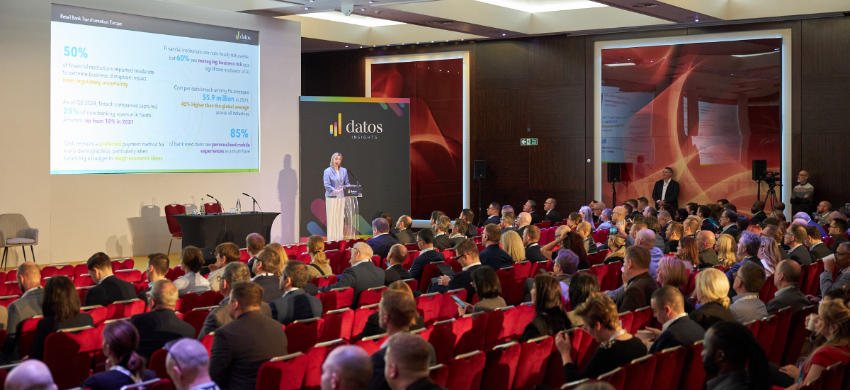
Reflections on Retail Bank Transformation Europe 2025
By Brendan Thorpe, Customer Success Manager at Auriga

Photo Credit © Joel Knight
The 2025 edition of Retail Bank Transformation Europe made one point unmistakably clear: retail banking is crossing a threshold where incremental digital improvement is no longer sufficient.
What is emerging instead is an industry compelled to rethink not only its systems and channels, but its very value proposition—to move beyond the mechanics of transactions and operate as a genuinely customer-centric, data-enabled service ecosystem.
AI in Retail Banking: From Incremental Automation to Exponential Personalisation
The conference opened with a keynote from Brett StClair, former Google executive and Barclays Digital Chief, whose argument was both simple and urgent: the convergence of customer-level AI and banking-level AI will redefine personalised services in the banking industry.
His assertion that banks must evolve “exponentially, not incrementally” resonated across discussions throughout the event. And he is right—digital capability is outpacing organisational readiness, and banks that fail to bridge that gap risk irrelevance.
That opening set the tone for many of the other sessions, with the challenge bank branch transformation now is not just to digitise existing services, but to reinvent the customer experience from the beginning.
A range of speakers emphasised that integrating emerging tools like Agentic AI, open banking APIs, and biometric security isn’t optional, but is now an essential to stay competitive in the banking space and truly meet customer needs.
Omnichannel Banking Strategies to Redesign the Customer Experience
The most powerful undercurrent beneath the digitisation topics was the need to retain and rediscover human connection. In discussions around branch evolution, many banks spoke of branches no longer serving as merely transactional hubs but fully built out advisory centers.
By automating routine tasks, banks aim to free up human advisors to focus on customer relationships, face-to-face guidance, and complex service and support, with that mix of technology and human touch standing out as a key theme.
From an Auriga perspective, this “branch-plus-digital” future isn’t just aspirational; it already exists today. Auriga’s WWS platform powers ATMs, kiosks, branch terminals, and digital channels in a fully omnichannel way.
It allows banks to unify touchpoints, providing seamless customer journeys whether someone chooses to interact online, via mobile, or in a branch. This is exactly the type of convergence many of the event sessions emphasised, with physical and digital services working together, not in isolation.
From Transactional Hubs to Advisory Centers
Another standout session explored the shift from transactional banking to a “holistic engagement” model. It outlined the need for banks to understand customers’ broader financial lives, including their context, lifecycle, and long-term value. This perspective aligns with Auriga’s approach, with the integration of data across channels enabling banks to deliver personalised services at scale without losing sight of operational efficiency.
The future of branch banking isn’t branch or digital, it’s branch and digital, plus smart self-service and data-driven cash infrastructure.
ATM Economics and the Future of Cash Access in Europe
Cash, in fact, was one of the most debated topics of the event. Participating in a panel alongside LINK’s Graham Mott, Euronet 360 Finance’s Daniel Marland, and Datos Insights’ Gillian Shaw, I shared perspectives on the sustainability challenges surrounding ATM economics.
The insights from Datos’ newly released whitepaper The Future of ATM Economics added critical context: the current financial model for ATMs is becoming unstable, interchange fees are contributing to cash deserts, and yet cash continues to play an essential role in financial inclusion across Europe.
This paradox highlights that banks and vendors need to modernise how they deliver and fund cash access. Despite the rapid growth of digital payments, cash circulation in many European markets remains strong. With this, financial institutions must therefore ensure continued access while modernising their infrastructure.
By enabling banks to maintain reliable ATM networks, optimise cash management, and seamlessly integrate these channels with digital services, Auriga helps the future of ATM in Europe to ensure that access to cash remains sustainable, resilient, and aligned with evolving customer preferences.
Risk Management and Fraud Prevention as Pillars of Retail Banking Trust
Finally, risk management and fraud prevention banking emerged as a critical, recurring theme at the event. As banks accelerate the adoption of AI, expand digital services, and automate more processes, the imperative to maintain strong security, compliance, and fraud-prevention frameworks intensifies.
Confidence in these controls is no longer a back-office concern, but a prerequisite for innovation itself, enabling transformation to move forward at pace and at scale.
Against a backdrop of rapidly evolving and increasingly sophisticated fraud threats, traditional “add more barriers” approaches are proving ineffective. Instead, discussions noted that institutions are shifting towards smarter, AI-driven prevention models built on real-time monitoring, transaction pattern analysis, and behavioural insights.
The emphasis is on proactive detection rather than reactive response, with intelligent tools empowering frontline teams to manage complex, high-risk, and emotionally sensitive fraud cases more effectively, protecting customers while preserving trust and experience.
Redefining Retail Banking Around Customer Needs and Trust
Leaving the event, one conclusion felt unavoidable: success in 2025 will not be measured by how digital or automated a bank becomes, but by how effectively it combines intelligence with empathy, data with judgment, and convenience with trust.
Modern infrastructure will be the enabler of this shift, empowering banks to innovate boldly while remaining reliable and human-centred.
What stood out to me most was a renewed understanding that customers, not products, must anchor every strategic decision. And the technologies needed to support this shift are not theoretical or distant. They are available today, already powering institutions that recognise that the next era of retail banking will belong to those who can design experiences around people, not processes.